
Pressure Points for Anxiety: 11 Calming Points to Quiet a Racing Mind (2026)
If your chest feels tight and your thoughts keep looping, you are not alone. Anxiety has a way of hijacking the body before the mind even catches up. Your shoulders climb toward your ears, your jaw clenches, your breathing goes shallow. And the more you try to think your way out of it, the worse it gets.
I have been using acupressure since 2017 to manage my own anxiety patterns, and the thing that surprised me most is how fast the body responds to the right kind of pressure. Not because acupressure is magic. Because anxiety lives in your nervous system, and pressure points give you a direct line to calm it down.
This guide covers the 11 acupressure points I rely on most when anxiety hits. Each one targets a different piece of the puzzle â racing thoughts, chest tightness, shallow breathing, muscle tension. I will walk you through exactly where to find them, how to press them, and which combinations work best when everything feels like too much.
How Acupressure Helps With Anxiety
Anxiety is not just a mental state. It is a full-body event. Your sympathetic nervous system fires up, pumping cortisol and adrenaline, tightening your muscles, and sending your heart rate climbing. This is the fight-or-flight response doing its job â except there is nothing to fight or flee from.
Acupressure works by stimulating specific points along the body’s meridian pathways, which sends signals through the nervous system to shift you from that sympathetic overdrive back into parasympathetic mode. Think of it as pressing a reset button on your body’s stress response.
Research supports this. A 2015 study in the Journal of Acupuncture and Meridian Studies found that acupressure significantly reduced anxiety levels in patients before surgery. A 2018 meta-analysis in Complementary Therapies in Clinical Practice confirmed that acupressure interventions reduced anxiety across multiple clinical settings with moderate to large effect sizes.
The beauty of acupressure for anxiety is that you can do it anywhere â at your desk, in a waiting room, in bed at 2 AM when your brain will not shut up. No equipment needed. No side effects. Just your hands.
Pericardium 6 (PC 6) â Nei Guan
This is the first point I reach for when anxiety hits my chest. PC 6 is the go-to for that tight, constricted feeling that makes you feel like you cannot get a full breath.
Where to find it: Hold your arm out with your palm facing up. Measure three finger-widths down from the crease of your wrist, right in the center between the two tendons.
How to press: Use your thumb to apply firm, steady pressure. Hold for 60 to 90 seconds while breathing slowly and deeply. You might feel a slight ache or warmth spreading through your forearm â that is normal.
Why it works for anxiety: PC 6 is called the “Inner Gate” in Traditional Chinese Medicine. It regulates the chest, calms the heart, and settles the stomach. If your anxiety comes with nausea or that sick feeling in your gut, this point hits both at once.
I press this point on the bus, in meetings, under the table at dinner. Nobody notices, and it genuinely takes the edge off within a minute or two.
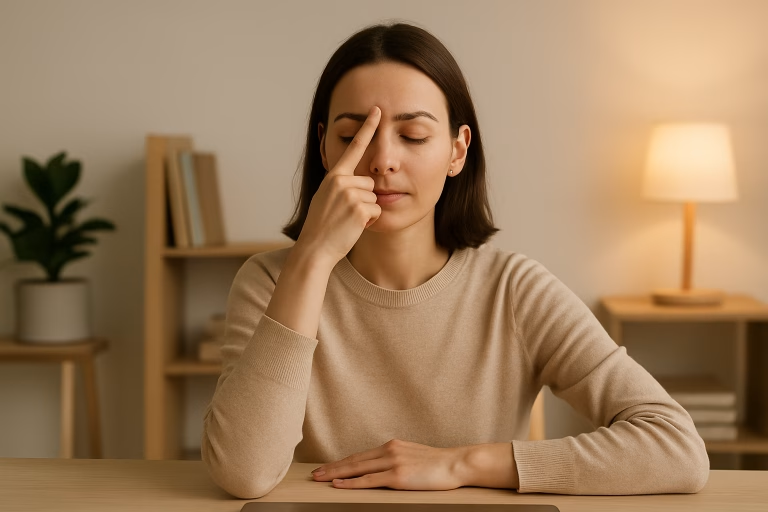
Yin Tang â Third Eye Point
When your thoughts are spinning and you cannot focus on anything, Yin Tang cuts through the noise. This is the point that brings you back to center.
Where to find it: Right between your eyebrows, in the small indentation where the bridge of your nose meets your forehead.
How to press: Use your middle finger or thumb to apply gentle, steady pressure. Close your eyes. Hold for 60 to 90 seconds. Breathe in through your nose and out through your mouth.
Why it works for anxiety: Yin Tang calms the mind and settles what Traditional Chinese Medicine calls the “Shen” â your spirit or consciousness. Modern research connects it to reduced activity in the amygdala, the brain’s fear center. A 2019 study in Evidence-Based Complementary and Alternative Medicine found that Yin Tang stimulation significantly lowered subjective anxiety scores.
This is the point I use when I am lying in bed and my mind will not stop replaying every conversation from the day. Press, breathe, and the mental chatter gets quieter.
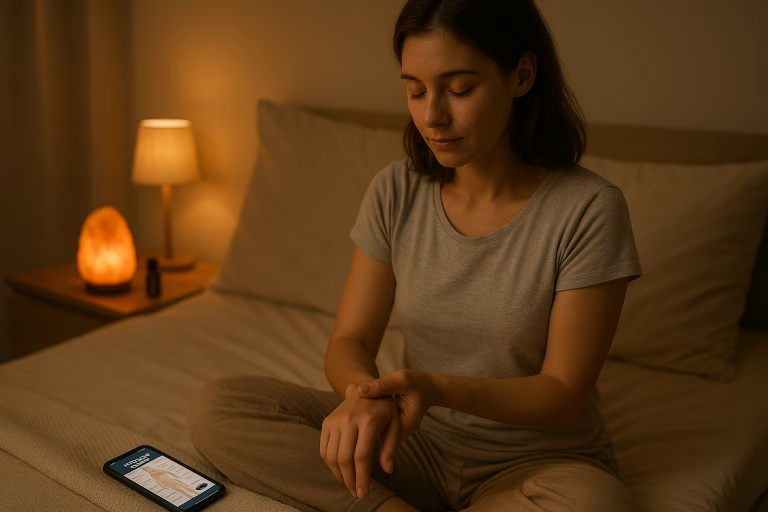
Heart 7 (HT 7) â Shen Men
If PC 6 is for chest anxiety, HT 7 is for emotional anxiety. The kind that feels like sadness and worry tangled together, where you cannot tell if you are scared or just deeply unsettled.
Where to find it: On the inner wrist crease, on the pinky side. Feel for the small depression just inside the tendon that runs along the edge of your wrist.
How to press: Apply gentle but firm pressure with your thumb. Hold for 60 seconds, then switch wrists. You can also do small circular motions here â whatever feels like it is releasing tension.
Why it works for anxiety: HT 7 translates to “Spirit Gate” and it is the primary point on the Heart meridian for calming emotional disturbances. It addresses anxiety that comes with insomnia, restlessness, and that feeling of your heart being unsettled.
This is my evening point. I press HT 7 on both wrists before bed, especially on nights when my mind is carrying worries I cannot put down.
Liver 3 (LV 3) â Tai Chong
Anxiety does not always look like panic. Sometimes it looks like irritability, frustration, tension headaches, and a jaw clenched so tight you wake up with a sore face. That is Liver Qi stagnation in Chinese medicine, and LV 3 is the release valve.
Where to find it: On the top of your foot, in the webbing between your big toe and second toe. Slide your finger up from the web space about two finger-widths until you hit a tender spot in the depression between the metatarsal bones.
How to press: Use your thumb to press firmly. This point is often tender on people who carry stress and frustration. Hold for 60 to 90 seconds per foot. Breathe into the discomfort.
Why it works for anxiety: LV 3 is called “Great Surge” and it moves stagnant energy, relieves tension headaches, loosens tight muscles, and calms irritability. Combined with LI 4 (see below), it forms the “Four Gates” â one of the most powerful acupressure combinations for full-body anxiety relief.
If your anxiety makes you snappy and tense rather than scared and frozen, start with this point.
Large Intestine 4 (LI 4) â He Gu
LI 4 is the Swiss Army knife of acupressure points. Pain, tension, headaches, anxiety â it addresses all of them. It is also the easiest point to find and press discreetly.
Where to find it: On the back of your hand, in the fleshy mound between your thumb and index finger. Squeeze your thumb and index finger together â the point is at the highest spot of that mound.
How to press: Use the thumb and index finger of your other hand to pinch and press firmly. Hold for 60 seconds per hand. You should feel a deep, satisfying ache.
Why it works for anxiety: LI 4 is one of the most studied acupressure points in clinical research. It releases endorphins, reduces cortisol, and has a strong calming effect on the entire upper body. A 2017 study published in Brain Research found that stimulating LI 4 modulated activity in brain regions associated with anxiety and emotional regulation.
Important: Do not use this point if you are pregnant, as LI 4 can stimulate uterine contractions.
I use LI 4 and LV 3 together â the Four Gates combination â when anxiety feels like it is everywhere and I need a full reset.
Gallbladder 21 (GB 21) â Jian Jing
You know that feeling where anxiety turns your shoulders into rocks? GB 21 lives right in the middle of that tension.
Where to find it: On the top of your shoulder, halfway between the base of your neck and the tip of your shoulder. Press around until you find the spot that makes you go “ah, there it is.”
How to press: Use your opposite hand to press down firmly with your fingertips or thumb. Hold for 30 to 60 seconds. You can also do a kneading motion, like you are working dough. Switch sides.
Why it works for anxiety: GB 21 releases the trapezius muscle, which is one of the first muscles to tighten when anxiety activates your fight-or-flight response. Releasing this point drops your shoulders, opens your chest, and allows deeper breathing.
Important: Avoid this point during pregnancy.
This is a point I ask my partner to press when I am really wound up. Having someone else apply pressure to GB 21 while you breathe deeply is remarkably calming.
Governing Vessel 20 (GV 20) â Bai Hui
When anxiety makes you feel disconnected from your body â like you are floating or watching yourself from outside â GV 20 brings you back down to earth.
Where to find it: At the very top of your head, along the midline. Draw an imaginary line from the tops of both ears over the crown of your head. GV 20 is where that line meets the center.
How to press: Use your fingertip to apply gentle downward pressure. Hold for 60 seconds. You can also tap this point lightly and rhythmically, which some people find more grounding.
Why it works for anxiety: GV 20 means “Hundred Meetings” because it is where all the Yang meridians converge. It lifts mood, clears the mind, and treats anxiety that comes with dizziness, dissociation, or brain fog. It is also one of the most commonly used points in acupuncture for depression and anxiety disorders.
I use GV 20 when anxiety makes me feel spacey and ungrounded. A minute of firm pressure and I feel more present, more in my body.
Kidney 1 (KD 1) â Yong Quan
If GV 20 is at the top, KD 1 is at the bottom. This is the most grounding point on the body â literally the point where you connect to the earth.
Where to find it: On the sole of your foot, in the depression that forms when you curl your toes. It is roughly one-third of the way from the base of your toes to your heel, right in the center.
How to press: Use your thumb to press firmly. KD 1 can be intense, so start with moderate pressure and increase gradually. Hold for 60 to 90 seconds per foot.
Why it works for anxiety: KD 1 is called “Gushing Spring” and it is the lowest point on the body. It draws excess energy downward, which is exactly what you need when anxiety sends everything rushing to your head and chest. It calms panic, reduces the sensation of a racing heart, and helps with anxiety-related insomnia.
When anxiety wakes me up at night, I press KD 1 on both feet for a minute each. It is like telling my nervous system that I am safe and grounded.
Conception Vessel 17 (CV 17) â Shan Zhong
If your anxiety lives in your chest â that heavy, tight, “I can’t breathe” feeling â CV 17 is the point that opens it up.
Where to find it: In the center of your chest, on the breastbone, level with your nipples. You can find it by placing your fingers on the sternum and sliding to the spot that feels slightly tender.
How to press: Use two or three fingertips to press gently into the breastbone. You do not need heavy pressure here â the chest is sensitive. Hold for 60 seconds while taking slow, deep breaths. You can also do slow circular motions.
Why it works for anxiety: CV 17 is called “Chest Center” and it is the primary point for opening the chest, regulating breathing, and calming the heart. In Chinese medicine, it is the influential point of Qi, meaning it governs the flow of energy throughout the body. When anxiety constricts your chest, CV 17 tells it to let go.
I combine CV 17 with deep breathing when anxiety hits my chest. Press the point, inhale for 4 counts, hold for 4, exhale for 6. The chest opens noticeably within a few breaths.
Gallbladder 20 (GB 20) â Feng Chi
Anxiety headaches and neck tension live right at GB 20. If your anxiety manifests as a band of tightness around the base of your skull, this point breaks it up.
Where to find it: At the base of your skull, in the two hollows on either side of the thick neck muscles. Tilt your head slightly back and feel for the depressions just below the occipital bone.
How to press: Use both thumbs to press upward and inward toward the center of your skull. Hold for 60 to 90 seconds. You may feel the tension releasing like a knot slowly untying.
Why it works for anxiety: GB 20 is called “Wind Pool” and it treats headaches, neck tension, dizziness, and mental fog â all common companions of chronic anxiety. It also improves blood flow to the brain, which helps with the clarity and focus that anxiety steals from you.
This is the point I go to after a long day of screen time when anxiety and tension headaches merge into one throbbing mess.
Ear Shen Men â Auricular Point
Your ear has its own anxiety reset button. Auricular (ear) acupressure has become one of the most studied forms of acupressure for anxiety, and Shen Men is the star player.
Where to find it: In the upper third of your ear, in the triangular depression called the triangular fossa. It is roughly at the apex of the triangular hollow in the upper ear.
How to press: Use your thumb behind the ear for support and your index finger on the front. Pinch and press gently for 60 seconds. You can also use a small, circular rubbing motion. Do both ears.
Why it works for anxiety: Ear Shen Men (meaning “Spirit Gate” â same name as HT 7) stimulates the vagus nerve, which is the master switch for your parasympathetic nervous system. A 2020 randomized controlled trial in Journal of Clinical Nursing found that auricular acupressure at Shen Men significantly reduced anxiety in pre-operative patients compared to sham acupressure.
I keep small ear seeds (tiny adhesive beads) on this point during high-anxiety weeks. Every time I press the seed, I get a little hit of calm throughout the day.
5-Minute Anxiety Relief Routine
When anxiety flares up, you do not need to hit all 11 points. Here is my go-to sequence that takes about 5 minutes and covers the most ground:
- Minutes 0-1: Press Yin Tang (between eyebrows) with eyes closed. Focus on slow breathing.
- Minutes 1-2: Press PC 6 (inner wrist) on both wrists, 30 seconds each. Breathe into the chest.
- Minutes 2-3: Press HT 7 (wrist crease, pinky side) on both wrists, 30 seconds each.
- Minutes 3-4: Press LI 4 (hand web) on both hands, 30 seconds each. Let the jaw unclench.
- Minutes 4-5: Press Ear Shen Men on both ears, 30 seconds each. Finish with three deep breaths.
This sequence moves from the head down through the arms and hands, finishing with the ears and vagus nerve stimulation. By the end, your breathing should be slower, your shoulders lower, and that chest tightness noticeably reduced.
I do this routine in the bathroom at work when anxiety peaks, and I do a longer version before bed on tough nights. It works whether the anxiety is mild background noise or a full-blown wave.
Using an Acupressure Mat for Anxiety
Here is something most anxiety guides will not tell you: an acupressure mat can do the work of pressing multiple points at once. When you lie on a mat, hundreds of acupressure points along your back, neck, and shoulders get stimulated simultaneously.
For anxiety specifically, lying on an acupressure mat activates the parasympathetic nervous system across a wide area of the back. The initial sensation is intense â your body reads it as stimulation and responds by flooding you with endorphins and oxytocin. Within 10 to 15 minutes, most people experience a noticeable drop in tension and mental chatter.
I use my Pranamat almost every evening as a wind-down ritual. Twenty minutes on the mat with the lights low, and my anxiety levels drop more than any single pressure point session can achieve. It is like pressing a dozen calming points at once.
The key for anxiety is consistency. Using an acupressure mat 3 to 4 times per week creates a cumulative calming effect. Your nervous system starts to recalibrate its baseline, and you may notice that it takes more to trigger your anxiety response over time.
If you are new to acupressure mats, start with a thin t-shirt between you and the mat and work up to direct skin contact over a week or two. The initial intensity is part of how the mat works â it activates endorphin release â but it should not feel unbearable.
What the Research Says About Acupressure and Anxiety
The evidence for acupressure as an anxiety intervention has been growing steadily:
- A 2018 systematic review in Complementary Therapies in Clinical Practice analyzed 15 randomized controlled trials and found acupressure significantly reduced anxiety with moderate to large effect sizes across different populations.
- A 2015 study in the Journal of Acupuncture and Meridian Studies showed that acupressure at PC 6 reduced pre-operative anxiety by 30% compared to sham acupressure.
- A 2020 meta-analysis in the Journal of Integrative Medicine confirmed that auricular acupressure effectively reduced anxiety in clinical settings with minimal side effects.
- Multiple studies have documented the role of acupressure in stimulating vagus nerve activity, which directly counteracts the sympathetic nervous system response that drives anxiety.
Acupressure is not a replacement for professional treatment if you have severe or chronic anxiety. But as a complementary tool â something you can use alongside therapy, medication, or other practices â the evidence is solid.
Building an Anti-Anxiety Daily Routine
Acupressure works best as part of a broader daily practice rather than a one-time emergency fix. Here is how I structure my anxiety management:
- Morning (2 minutes): Press GV 20 and Yin Tang while sitting on the edge of the bed. This sets a calm tone before the day starts.
- Midday (2 minutes): Press LI 4 and PC 6 at my desk. These are discreet and address the tension that builds through a workday.
- Evening (20 minutes): Lie on my Pranamat acupressure mat. This is the anchor of my routine and handles full-body nervous system reset.
- Before bed (3 minutes): Press HT 7, KD 1, and Ear Shen Men. These points target insomnia and racing thoughts specifically.
You do not have to follow this exact schedule. Start with whatever feels manageable. Even one point pressed for one minute when you notice anxiety rising is better than doing nothing. The habit builds on itself.
When to Seek Professional Help
Acupressure is a powerful self-care tool, but it has limits. Please talk to a healthcare professional if:
- Your anxiety prevents you from going to work, leaving the house, or maintaining relationships
- You experience panic attacks that feel like heart attacks
- Your anxiety comes with persistent intrusive thoughts or compulsive behaviors
- You are using alcohol, drugs, or other substances to cope with anxiety
- Your anxiety symptoms have lasted more than six months and are getting worse
- You have thoughts of self-harm or suicide
Acupressure works alongside professional treatment, not instead of it. Many therapists and psychiatrists are supportive of acupressure as a complementary practice.
The Bottom Line
Anxiety lives in your body as much as it lives in your mind. Acupressure gives you a way to talk to your nervous system directly â to tell it that you are safe, that it can stand down, that you do not need to be in fight-or-flight mode right now.
The 11 points in this guide cover the full spectrum of anxiety symptoms: racing thoughts, chest tightness, muscle tension, irritability, insomnia, and that floating, disconnected feeling. You do not need to use all of them. Start with two or three that match your symptoms, practice the 5-minute routine when anxiety spikes, and build from there.
After nine years of daily acupressure practice, I can tell you that the difference is not just in the moments when you press the points. It is in the way your body learns to come back to calm faster. Your baseline shifts. The waves still come, but they do not knock you over as easily.
Your fingers are the best anxiety tools you own. Use them.
Frequently Asked Questions
How quickly do pressure points work for anxiety?
Most people feel a noticeable shift within 60 to 90 seconds of sustained pressure on a single point. The full 5-minute routine produces more significant relief. For chronic anxiety, the cumulative effect of daily practice over 2 to 4 weeks is where the real change happens. Do not expect one session to solve ongoing anxiety â think of it as training your nervous system.
Can I press too hard on anxiety pressure points?
Yes, but it is hard to do real damage with finger pressure. The ideal pressure is firm enough to create a dull ache but not sharp pain. If a point hurts sharply, ease off. For sensitive areas like Yin Tang and CV 17, lighter pressure works just as well. The goal is to stimulate the point, not cause pain.
Which pressure point is best for panic attacks?
For acute panic, I recommend starting with PC 6 (inner wrist) because it addresses the chest tightness and nausea that come with panic. Follow with Ear Shen Men (vagus nerve stimulation) and Yin Tang (mental calming). Press each for 30 seconds and focus entirely on slow, deep breathing. The combination of physical pressure and controlled breathing can interrupt the panic cycle.
Can I use acupressure alongside anxiety medication?
Yes. Acupressure has no known interactions with anxiety medications including SSRIs, SNRIs, benzodiazepines, or buspirone. Many people use acupressure as a complement to their medication, and some find that over time their reliance on medication decreases. Always discuss changes to your medication plan with your doctor.
Is there a pressure point for social anxiety specifically?
Social anxiety responds well to HT 7 (emotional calming) and LI 4 (tension release) because they are discreet â you can press them under a table during a meeting or social event. Before a social situation, try the Yin Tang point at home to calm anticipatory anxiety. The Four Gates combination (LI 4 + LV 3) is excellent for the broader tension and irritability that social anxiety creates.
How often should I do acupressure for anxiety?
For ongoing anxiety management, daily practice produces the best results. Even 5 minutes per day of targeted acupressure is beneficial. I do short sessions two to three times a day plus an evening acupressure mat session. During high-anxiety periods, you can press points as often as needed â there is no upper limit that is unsafe.
Do acupressure mats help with anxiety?
Absolutely. Lying on an acupressure mat stimulates hundreds of points simultaneously, triggering a broad parasympathetic nervous system response. A 2019 study found that participants who used acupressure mats regularly reported lower anxiety and improved sleep quality. I use my Pranamat mat every evening, and it is the single most effective anxiety tool in my daily routine.
Related Reading
- Pressure Points for Stress
- Pressure Points for Sleep
- Pressure Points for Back Pain
- How to Use Acupressure Mat for Lower Back Pain
- Acupressure Mat Benefits
📚 Clinical Studies: Acupressure for Anxiety
The information in this article is supported by peer-reviewed clinical research:
- Au DWH, Tsang HWH, Ling PPM, et al. Effects of Acupressure on Anxiety: A Systematic Review and Meta-Analysis. J Integr Complement Med. 2022;28(1):25-35
- Arslan DE, Khorshid L. The effects of acupressure on depression, anxiety and stress in patients with hemodialysis. Ren Fail. 2015;37(1):90-94
- Agarwal A, Ranjan R, Dhiraaj S, et al. Acupressure for prevention of pre-operative anxiety: a prospective, randomised, placebo controlled study. Anaesthesia. 2005;60(10):978-981
For more information about our research standards, visit our Editorial Process page.
Author

Free Mobile App
Find Pressure Points on the Go
Interactive 3D body map with 100+ acupressure points, step-by-step guides, and personalized routines.
Download Free App →