
Face Pressure Points: What Actually Works for Headaches, Sinus Pain, and Jaw Tension (2026)
If you have ever pressed your temples when a headache was building, you have already used face pressure points without realizing it. That instinct to press and hold is not random. You are targeting real acupressure points that have been used in traditional Chinese medicine for thousands of years.
I have been using facial acupressure since 2017, and it has become one of the most practical parts of my daily routine. Not for anything dramatic. Just for the things that come up constantly â sinus pressure, tension headaches, jaw tightness from stress, and the dull ache behind the eyes after too much screen time.
Here is what I have learned about which face pressure points actually work, how to use them correctly, and what the research supports.
The Best Face Pressure Points
These are the points I use most often. Each one has a specific purpose, and knowing which to use for what makes the difference between vague rubbing and targeted relief.
Yintang â Third Eye Point
This is probably the most well-known face pressure point, and for good reason. It works.
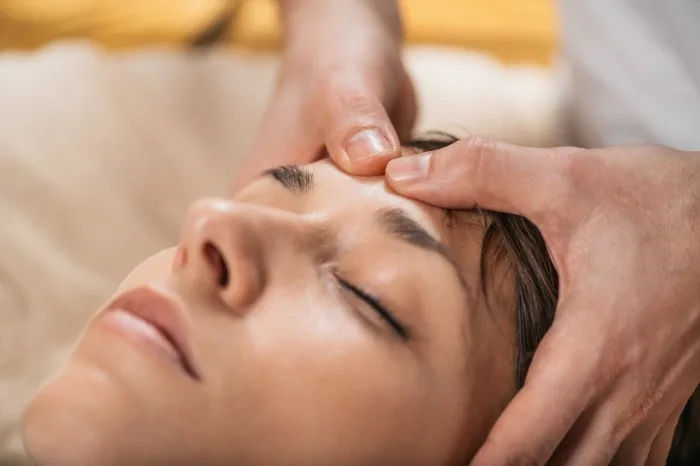
Location: Right between your eyebrows, in the small indentation where the bridge of the nose meets the forehead. You will feel a slight dip when you press there.
What it does: Yintang is the go-to point for frontal headaches, mental tension, and anxiety. It calms the nervous system and creates an almost immediate sense of relaxation. In TCM, it is considered one of the most powerful points for settling the mind. Research published in the Journal of Alternative and Complementary Medicine confirmed that stimulation of this point reduces anxiety levels significantly compared to sham points.
How to use it: Press gently with your middle finger or thumb. Use a steady, moderate pressure â not hard. Hold for 1 to 2 minutes while breathing slowly. You should feel a mild ache that spreads across the forehead. This point works well as a starting point before moving to other facial pressure points.
LI 20 â Yingxiang (Beside the Nose)
If you deal with sinus congestion, allergies, or a stuffy nose, this is the point you need to know.
Location: In the groove beside each nostril, at the point where the nostril flares out to meet the cheek. Press into the crease and you will find a tender spot.
What it does: LI 20 opens the nasal passages and relieves sinus pressure. It works remarkably fast â most people notice improved breathing within 1 to 2 minutes of sustained pressure. It is also effective for sinus headaches, loss of smell, and facial swelling from allergies. A clinical study found that acupressure at LI 20 significantly improved nasal airflow and reduced congestion scores in patients with chronic rhinitis.
How to use it: Press both sides simultaneously with your index fingers. Use firm, circular pressure for 1 to 2 minutes. You may feel a slight burning or warmth as the sinuses begin to open. For best results, press while breathing deeply through whatever airflow you have â this helps the sinuses respond to the stimulation.
ST 3 â Juliao (Cheekbone)
ST 3 is essential for sinus pain, facial tension, and even toothache-related discomfort.
Location: Directly below the center of the eye, at the level of the bottom of the nose, in the depression of the cheekbone. Find the lowest point of your cheekbone and press into the slight hollow there.
What it does: ST 3 relieves sinus pressure in the maxillary sinuses â the large sinuses behind your cheekbones that cause the deep, aching facial pain during sinus infections or allergies. It also helps with facial puffiness, toothache in the upper jaw, and general facial tension. In TCM, it is a key point for clearing the face and improving circulation to the skin.
How to use it: Press firmly with your index or middle fingers on both sides of the face simultaneously. Hold for 1 to 2 minutes. The pressure should produce a deep ache in the cheekbone area. Combine with LI 20 for comprehensive sinus relief.
BL 2 â Zanzhu (Inner Eyebrow)
BL 2 is the point you want for eye strain, frontal headaches, and sinus pressure above the eyes.
Location: At the inner end of the eyebrow, in the small notch where the eyebrow begins near the bridge of the nose. Press along the inner edge of the brow bone and you will find a tender spot in a small depression.
What it does: BL 2 targets the frontal sinuses and relieves headaches that concentrate above and behind the eyes. It is particularly helpful for screen-related eye strain â the dull pressure that builds after hours of computer work. It also helps with blurry vision, excessive tearing, and the heavy-eyelid feeling that comes with fatigue.
How to use it: Press both points simultaneously with your thumbs while resting your other fingers on your forehead. Use upward pressure into the brow bone. Hold for 1 to 2 minutes. You may feel the pressure release as a slight opening sensation above the eyes.
SJ 21 â Ermen (In Front of the Ear)
This point is critical for jaw tension, TMJ pain, and ear-related issues.
Location: In front of the ear, in the depression that forms when you open your mouth. Place your finger right in front of your ear canal and open your jaw â you will feel a hollow space form. That is SJ 21.
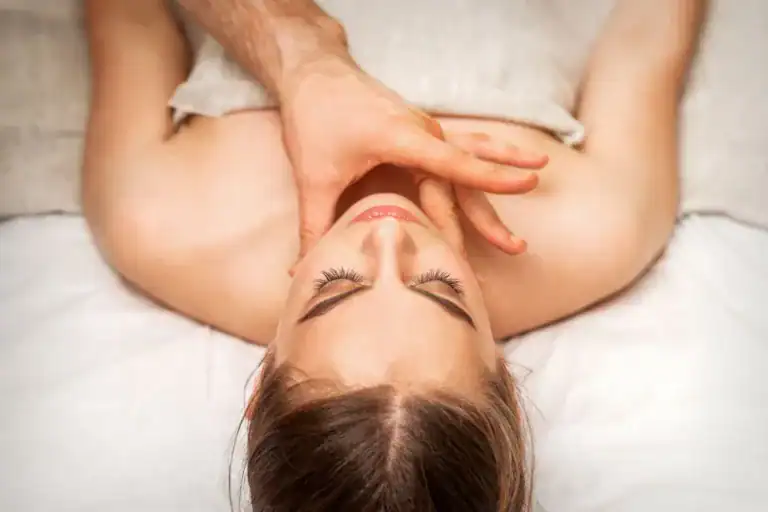
What it does: SJ 21 releases tension in the temporomandibular joint and the muscles of mastication â the muscles you use for chewing and clenching. If you grind your teeth at night, clench your jaw during stress, or have TMJ dysfunction, this point provides significant relief. It also helps with tinnitus, ear pain, and headaches that originate from jaw tension.
How to use it: Press gently with your index fingers on both sides while keeping your mouth slightly open. Hold for 1 to 2 minutes. The pressure should be moderate â the TMJ area is sensitive. You can add small circular motions to help release the surrounding muscle tension.
ST 6 â Jiache (Jaw Angle)
ST 6 works alongside SJ 21 for jaw tension and is particularly effective for teeth grinding.
Location: On the lower jaw, at the angle of the jawbone. Clench your teeth and feel the muscle that bulges on the side of your jaw. ST 6 is at the highest point of that muscle.
What it does: ST 6 directly targets the masseter muscle â one of the strongest muscles in the body and the primary muscle responsible for jaw clenching. When this muscle is chronically tight, it creates headaches, facial pain, and tooth sensitivity. Acupressure at ST 6 releases the masseter and provides relief from bruxism-related symptoms. Research has shown that masseter relaxation through pressure point stimulation reduces both pain intensity and frequency of jaw clenching episodes.
How to use it: Clench your teeth briefly to locate the muscle, then relax your jaw. Press firmly into the muscle belly with your index or middle fingers. Hold for 1 to 2 minutes per side, using slow circular motions. You will likely feel significant tenderness if you are a jaw clencher â start gently and increase pressure as the muscle releases.
GV 26 â Renzhong (Below the Nose)
GV 26 is a revival point â it is used for sudden dizziness, fainting, and mental clarity.
Location: In the groove between the nose and upper lip (the philtrum), approximately one-third of the way down from the nose.
What it does: GV 26 is a potent stimulation point that activates the central nervous system. It clears the mind, restores alertness, and is traditionally used as a first-aid point for loss of consciousness. For daily use, it helps with mental fog, afternoon drowsiness, and the kind of spacey feeling that comes with fatigue or low blood pressure. It also relieves lower back pain â which may seem counterintuitive, but the Governing Vessel meridian runs from the face down the entire spine.
How to use it: Press firmly with your fingertip using a slightly upward angle toward the nose. Hold for 30 seconds to 1 minute. The pressure should be strong enough to produce a sharp, alerting sensation. This is not a relaxation point â it is a wake-up point.
Taiyang â Temple Point
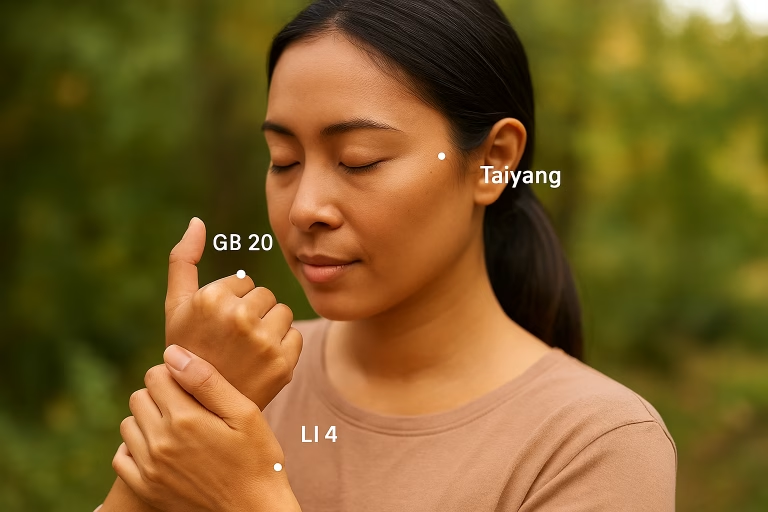
Taiyang is an extra point (not on a standard meridian) that is one of the most effective points for headaches.
Location: In the depression about one finger-width behind the midpoint between the outer end of the eyebrow and the outer corner of the eye. You will feel a slight hollow in the temple area.
What it does: Taiyang relieves temporal headaches, migraines, and eye pain. It is especially effective for the one-sided headaches and the throbbing pain that concentrates in the temple region. It also helps with dizziness and eye fatigue. Clinical studies have confirmed that acupressure at Taiyang significantly reduces headache intensity and duration compared to control treatments.
How to use it: Press both temples simultaneously with your thumbs or middle fingers. Use moderate, circular pressure for 1 to 2 minutes. You should feel a deep ache that gradually transforms into relief. This point works well in combination with Yintang for comprehensive headache treatment.
Practical Routines for Common Problems
For Sinus Congestion and Allergies
Start with LI 20 (beside the nose) for 2 minutes. Move to BL 2 (inner eyebrow) for 1 to 2 minutes. Follow with ST 3 (cheekbone) for 1 to 2 minutes. Finish with Yintang (third eye) for 1 minute. Total time is about 7 to 8 minutes. Do this 2 to 3 times daily during allergy season or sinus infections.
For Tension Headaches
Begin with Taiyang (temples) for 2 minutes. Move to Yintang (third eye) for 1 to 2 minutes. Follow with BL 2 (inner eyebrow) for 1 to 2 minutes. Add LI 4 on the hand (between thumb and index finger) for 1 to 2 minutes per hand for additional pain relief. Total time is about 8 to 10 minutes.
For Jaw Tension and TMJ
Start with SJ 21 (in front of ear) for 2 minutes with mouth slightly open. Move to ST 6 (jaw angle) for 2 minutes per side with circular motions. Follow with Taiyang (temples) for 1 minute to release surrounding tension. Do this every evening, especially if you grind your teeth at night. Total time is about 7 minutes.
For Eye Strain and Screen Fatigue
Press BL 2 (inner eyebrow) for 1 to 2 minutes. Follow with Taiyang (temples) for 1 to 2 minutes. Finish with Yintang (third eye) for 1 minute. Do this every 2 hours during extended screen work. Total time is about 4 to 5 minutes.
Tips for Better Results
Use clean hands. You are pressing on your face, so wash your hands first. This prevents transferring bacteria to sensitive areas around the nose, eyes, and mouth.
Close your eyes. Most facial pressure points work better when your eyes are closed. This reduces visual stimulation and helps your nervous system shift into relaxation mode.
Combine with breathing. Slow, deep breaths while pressing each point activates the parasympathetic nervous system and enhances the pain-relieving and relaxation effects of acupressure.
Be consistent. Like all acupressure, facial pressure points work best with regular use. A daily 5-minute routine produces better results than occasional longer sessions. Give it 2 to 3 weeks of consistent daily practice before evaluating effectiveness.
Do not press too hard around the eyes. The tissue around the eyes is delicate. Use gentle to moderate pressure for BL 2 and Taiyang. You should feel a dull ache, not sharp pain.
Using an Acupressure Mat for Facial Points
While an acupressure mat primarily targets the back, you can use the acupressure pillow (included with most mat sets) to stimulate pressure points on the back of the head, neck, and indirectly support facial tension relief.
The Pranamat pillow is what I use for this. When you lie on the pillow, the spikes stimulate the suboccipital muscles and the points at the base of the skull â GB 20 (Fengchi) and GV 16 (Fengfu). These points are closely connected to facial tension, headaches, and sinus issues. Releasing tension in the back of the head and neck often resolves facial pain and headaches that originate from postural tension.
Place the acupressure pillow under the base of your skull while lying on the mat. Start with 10 minutes and work up to 15 to 20 minutes. Many people find this particularly effective for headaches that start at the base of the skull and travel forward to the temples and forehead.
What the Research Says
The evidence for facial acupressure is well-established across several conditions.
Sinus relief: A randomized controlled trial published in the American Journal of Rhinology found that acupressure at nasal and facial points significantly improved sinus symptoms, including congestion, facial pain, and headache, compared to sham treatment.
Headache reduction: A systematic review in the Journal of Pain Research found that acupressure reduced headache frequency, intensity, and duration across multiple studies, with effects comparable to some medications but without side effects.
TMJ and jaw pain: Research in the Journal of Oral Rehabilitation demonstrated that acupressure to the jaw muscles significantly reduced pain and improved jaw function in patients with TMJ disorders.
Anxiety and stress: Studies have consistently shown that stimulation of Yintang and other facial points reduces cortisol levels and activates the parasympathetic nervous system, producing measurable reductions in anxiety.
When to See a Doctor
Facial acupressure is safe for most conditions, but some situations require medical evaluation.
See a doctor if you experience sudden, severe headaches unlike any you have had before, facial pain with fever and green or yellow nasal discharge lasting more than 10 days, jaw pain with inability to open or close your mouth, numbness or tingling in the face, or persistent facial swelling that does not respond to any treatment.
Acupressure is not a replacement for medical treatment of serious conditions. It works best as a complementary tool alongside proper care.
Bottom Line
Face pressure points are some of the most accessible and immediately effective acupressure points on the body. You do not need any tools â just your fingers and a few minutes.
For sinus issues, start with LI 20 and ST 3. For headaches, focus on Taiyang and Yintang. For jaw tension, work SJ 21 and ST 6. Build a short daily routine of 5 to 10 minutes and give it 2 to 3 weeks to see consistent results.
The face is densely packed with nerve endings and blood vessels, which is why acupressure tends to work faster here than on other parts of the body. Most people notice at least some effect within the first session.
Frequently Asked Questions
What is the best pressure point on the face for headaches?
Taiyang, located in the temple area about one finger-width behind the midpoint between the outer eyebrow and outer eye corner, is the most effective single point for headaches. Press both temples simultaneously with moderate circular pressure for 1 to 2 minutes. For frontal headaches, combine Taiyang with Yintang (the third eye point between the eyebrows) for comprehensive relief.
Can face pressure points help with sinus congestion?
Yes. LI 20, located in the crease beside each nostril, is the primary point for sinus congestion. Press both sides simultaneously with firm circular pressure for 1 to 2 minutes. Most people notice improved nasal airflow within the first minute. For complete sinus relief, combine LI 20 with ST 3 (on the cheekbone) and BL 2 (inner eyebrow) to target all three sinus areas.
How often should I do facial acupressure?
Daily sessions of 5 to 10 minutes produce the best results. For acute problems like sinus congestion or headaches, you can do 2 to 3 shorter sessions throughout the day. For chronic conditions like TMJ or recurring headaches, a consistent daily routine is more effective than occasional longer sessions. Most people notice meaningful improvement within 2 to 3 weeks of daily practice.
Is facial acupressure safe?
Facial acupressure is safe for most people when done correctly. Use gentle to moderate pressure, especially around the eyes where tissue is delicate. Avoid pressing on broken skin, active acne, or inflamed areas. If you have a diagnosed facial condition, recent facial surgery, or dental implants near the jaw points, check with your healthcare provider before starting.
Can acupressure help with TMJ and jaw clenching?
Yes. SJ 21 (in front of the ear) and ST 6 (at the jaw angle) are effective points for TMJ pain and jaw clenching. Press SJ 21 with your mouth slightly open for 2 minutes, then work ST 6 with circular motions for 2 minutes per side. Do this routine every evening. Research shows acupressure to the jaw muscles significantly reduces TMJ pain and improves jaw function over time.
Do face pressure points help with anxiety?
Yes. Yintang, the point between the eyebrows, is one of the most researched points for anxiety reduction. Clinical studies have shown it reduces cortisol levels and activates the relaxation response. Press gently for 1 to 2 minutes while breathing slowly and deeply. Combine with slow breathing for maximum effect. Many people use this point before stressful events like presentations or difficult conversations.
What is the difference between facial acupressure and face mapping?
Facial acupressure uses specific pressure points along meridian pathways to relieve symptoms like headaches, sinus congestion, and jaw pain through sustained finger pressure. Face mapping is a diagnostic concept from TCM where different zones of the face correspond to internal organs. They are related but different â acupressure is a treatment technique, while face mapping is a diagnostic framework.
Related Reading
- Acupressure Mat Benefits: What Daily Use Actually Does
- Pressure Points for Stress Relief
- Pressure Points for Sleep
- Do Acupressure Mats Work? What the Evidence Really Says
- Pressure Points for Back Pain Relief
Author

Free Mobile App
Find Pressure Points on the Go
Interactive 3D body map with 100+ acupressure points, step-by-step guides, and personalized routines.
Download Free App →