Pressure Points That Stop Motion Sickness Fast
If you’re searching for motion sickness pressure points, start with one spot I use constantly with clients who get queasy in cars, boats, planes, and even VR rides: the inner-wrist point called P-6 Neiguan. When nausea hits, your nervous system and gut can get stuck in a loop – dizziness, stomach fluttering, cold sweat, then that “I need fresh air now” feeling. In my 10+ years of acupressure practice, I’ve found that a simple, well-timed technique on the right points can calm that loop fast, especially when you apply it before symptoms peak.
Quick Answer / Key Points
The most reliable motion sickness pressure points routine is to stimulate P-6 Neiguan on both wrists for 2-3 minutes, then add 1-2 supporting points based on your symptoms (dizziness, headache, anxiety, bloating).
Try this mini-sequence:
- Press P-6 Neiguan (inner wrist) – firm, steady circles for 2-3 minutes per wrist.
- If your stomach feels “off,” add ST-36 Zusanli (below knee) – 60-90 seconds per side.
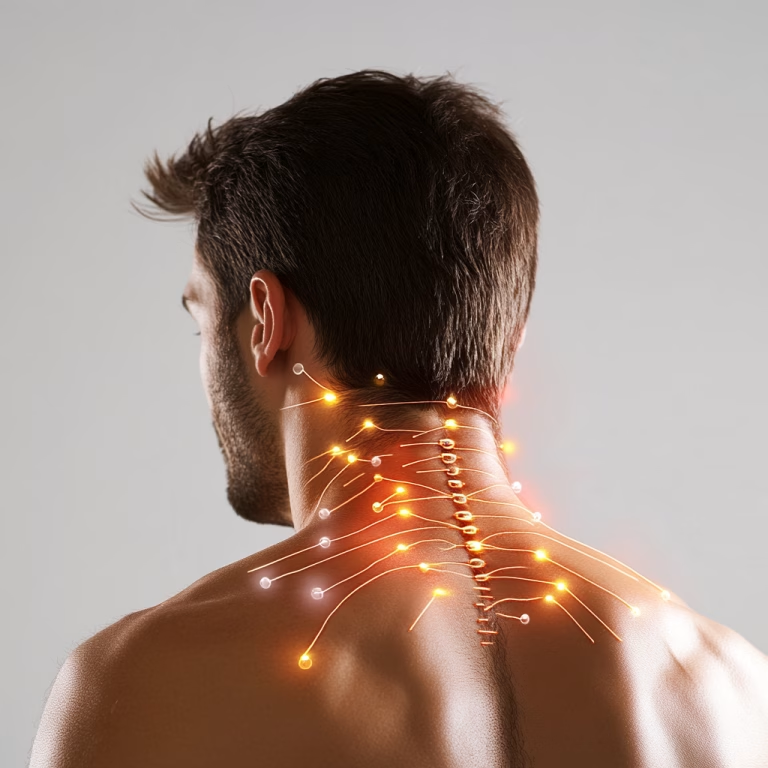
- If you’re dizzy or head-heavy, add GB-20 Fengchi (base of skull) – gentle inward circles for 30-60 seconds.
- If anxiety makes nausea worse, add CV-17 Danzhong (center chest) – soft palm pressure with slow breathing for 60 seconds.
Most people feel a shift within 1-5 minutes, especially if they start early.
Pressure Point Reference (5-8 core points)
| Point | Name | Location | Key Benefit |
|---|---|---|---|
| P-6 Neiguan | Inner Pass | 2-3 finger-widths below wrist crease, between the two tendons | Nausea, gagging, “rolling” stomach |
| ST-36 Zusanli | Leg Three Miles | 4 finger-widths below kneecap, one finger-width lateral to shin bone | Digestive steadiness, appetite, fatigue-related nausea |
| GB-20 Fengchi | Wind Pool | Hollows at base of skull, between neck muscles | Dizziness, head pressure, motion-triggered headache |
| CV-17 Danzhong | Chest Center | Midline of chest, level with nipples (center of sternum) | Tight chest, anxious nausea, shallow breathing |
| LI-4 Hegu | Joining Valley | Web between thumb and index finger | Headache, facial tension that rides with nausea |
| SP-4 Gongsun | Grandfather Grandson | Inner foot, just below base of big toe bone | Nausea with bloating, “upward” stomach sensation |
| PC-8 Laogong | Palace of Labor | Center of palm where middle finger lands | Calms agitation, helps when nausea is stress-driven |
| CV-12 Zhongwan | Middle Epigastrium | Midline abdomen, halfway between navel and sternum base | “Heavy stomach,” indigestion, fullness |
If you ever struggle to find these points or judge pressure, the free Pressure Points Guide App walks you through each step.
How to Apply These Points (Step-by-Step)
Sea-Band Acupressure Wrist Bands for Nausea Relief
Sea-Band Acupressure Wrist Bands earn a strong 4.6-star rating from over 12,400 Amazon reviews, with users frequently highlighting their drug-free effectiveness for motion sickness, pregnancy nausea, and chemotherapy side effects. While not universally effective and occasionally prone to slipping, the reusable design and affordability at around $12.99 make it a top non-medication recommendation for nausea relief, backed by consistent positive feedback across Amazon and Reddit communities.
This is the exact framework I teach for travel days because it’s simple, discreet, and repeatable.
-
Prepare your body (15 seconds).
Sit facing forward if possible. Put one hand on your belly and take 3 slow breaths. Keep your gaze stable (horizon or a fixed point). -
Find the point carefully (20-30 seconds).
For P-6 Neiguan, turn your palm up. Place 3 fingers of your other hand across the wrist crease. The point sits just below your index finger, centered between the two firm tendons. -
Apply the right pressure (2-3 minutes).
Use your thumb pad. Press until you feel a dull ache or “good soreness,” not sharp pain. Make small circles or hold steady. -
Coordinate with breathing (throughout).
Inhale through the nose for 4 seconds, exhale for 6-8 seconds. On the exhale, soften your shoulders and jaw. -
Repeat on the other side (2-3 minutes).
I usually do both wrists even if symptoms feel one-sided. -
Add one support point (1-2 minutes).
Choose ST-36 Zusanli for digestive wobble, GB-20 Fengchi for dizziness, or CV-17 Danzhong for anxious nausea.
What to expect: warmth, a spreading sensation down the forearm, a sigh, burping, or the stomach “settling.” Those are common signs you’ve hit the right spot.
Motion sickness pressure points: Why P-6 Neiguan is the first point I use
Motion Sickness Relief Ginger Chews by The Ginger People, 4 oz
The Ginger People’s Motion Sickness Relief Ginger Chews earn a strong 4.6-star rating from over 8,893 Amazon reviews, with praise for effective nausea relief and authentic ginger flavor at around $18.48, making it a solid affiliate recommendation for natural motion sickness support despite no third-party testing data or confirmed ASIN.
When motion sickness starts, most people focus on the stomach – but the trigger is often a mismatch between what your eyes see and what your inner ear feels. That mismatch can flip the autonomic nervous system into a nausea response. In Traditional Chinese Medicine (TCM), nausea and vomiting are often described as “rebellious Stomach Qi” rising upward instead of descending.
That’s why P-6 Neiguan is such a classic choice. It’s on the Pericardium meridian (Jueyin), and in TCM it’s used to “harmonize the Stomach” and calm the chest. In modern terms, it’s one of the best-studied acupressure points for nausea across several causes.
What the research says (and what it means for travelers)
Clinical sources widely describe P-6 Neiguan stimulation as a reasonable, low-risk option for nausea. Memorial Sloan Kettering Cancer Center explains how to use acupressure for nausea and vomiting, including P-6 Neiguan, in their patient education on acupressure for nausea.
For motion-related nausea specifically, a controlled trial published in the journal Aviation, Space, and Environmental Medicine found that wristband pressure over P-6 Neiguan reduced subjective motion sickness symptoms and abnormal gastric activity compared with control days, based on the PubMed-indexed clinical trial abstract.
And while post-operative nausea isn’t identical to seasickness, it shares nausea pathways. An NHS Trust patient resource describes using pressure points to relieve nausea, including P-6 Neiguan, in their guide on using pressure points for nausea relief.
How I apply P-6 Neiguan in real life (not just in theory)
This is the practical detail that matters: timing.
- Best time to press: 10-15 minutes before travel, then again at the first hint of queasiness.
- If you’re already nauseated: press one wrist while breathing slowly, then switch.
- If you use a wristband: make sure the bead sits directly on P-6 Neiguan – too high or too low often makes people think “it doesn’t work.”
Quick self-check: when you press the right spot, many clients say it feels “tender in a specific way,” not just general pressure.
Mini visual checklist for P-6 Neiguan
- Palm facing up
- 2-3 finger-widths below wrist crease
- Between two tendons (you can feel them when you flex your wrist)
- Firm, not painful
- 2-3 minutes per wrist
If nausea comes with dizziness and that “hungover spin” sensation, you’ll also like my guide to acupressure points for nausea and dizziness, because the point combinations overlap more than you’d think.
Supporting points for travel sickness relief (match the point to your symptom pattern)
Acupressure Point Finder – Pressure Point Guide App
This appears to be a mobile app for acupressure guidance rather than a physical product sold on Amazon.com. No matching ASIN or product listing was found after searching Amazon.com, so it cannot be recommended as an affiliate product. Consider searching app stores like Google Play or Apple App Store directly for availability and reviews.
Once P-6 Neiguan is on board, the next step is choosing the right support point. Motion sickness isn’t one sensation – it’s a cluster: nausea, dizziness, headache, burping, cold sweat, anxiety, sometimes even neck tension from bracing.
Below are the add-ons I reach for most, with a simple “when to use it” guide.
If your nausea comes with bloating or a heavy stomach: ST-36 Zusanli and CV-12 Zhongwan
This matters because motion sickness can disrupt normal stomach rhythm. In TCM language, the Stomach and Spleen system loses its descending function, and the middle burner feels clogged.
Try this pairing:
- ST-36 Zusanli (both legs): press with your thumb for 60-90 seconds each side.
- CV-12 Zhongwan: use a gentle palm hold (not deep poking) for 60 seconds while exhaling slowly.
What to expect: stomach gurgling, a deeper breath, sometimes a small burp. Those are often good signs.
If you tend to get digestive discomfort even when you’re not traveling, you may also want to explore the back-shu points used traditionally to regulate digestion, like the Stomach Shu (BL-21) Pressure Point and the Diaphragm Shu (BL-17) Pressure Point. I often use those as part of a longer-term plan for people who get nausea easily.
If dizziness and head pressure are the main issue: GB-20 Fengchi plus LI-4 Hegu
This matters because some motion sickness is more “head-led” than “stomach-led.” You feel swimmy, your eyes can’t settle, and nausea follows.
- GB-20 Fengchi: place your thumbs in the hollows under the skull on both sides. Press inward and slightly upward, very gently, for 30-60 seconds.
- LI-4 Hegu: squeeze the web between thumb and index finger for 30-60 seconds per hand.
Technique tip: GB-20 Fengchi should not feel like you’re jamming your neck. Think “inviting the tissues to soften,” not forcing.
When headache, nausea, and tight shoulders travel together, I often recommend browsing our broader acupressure category for related neck and stress routines to use between trips.
If anxiety makes nausea spiral: CV-17 Danzhong and PC-8 Laogong
This matters because fear of vomiting can become its own trigger. I see this a lot with flying, long bus rides, and boats – the nervous system braces, breathing gets shallow, and nausea worsens.
Try this calming combo:
- CV-17 Danzhong: rest your palm over the center of your chest. Apply light pressure (think: “comforting weight”) for 60-90 seconds.
- PC-8 Laogong: press the center of your palm with your thumb for 30-60 seconds, then switch hands.
What to expect: a spontaneous deeper inhale, softer throat, less “panic nausea.” If you’re prone to palpitations with nausea, you might also explore the Connecting Li (HT-5) Pressure Point as a steadying point in your at-home routine.
If nausea feels “upward” with burping or reflux: SP-4 Gongsun plus P-6 Neiguan
This matters because some people don’t just feel nauseated – they feel a rising sensation in the throat or upper belly.
- SP-4 Gongsun: press on the inner foot just below the big toe mound for 60 seconds per side.
- Follow with P-6 Neiguan again for 60-90 seconds per wrist.
In TCM, SP-4 Gongsun is often used to regulate the Chong Mai (Penetrating Vessel), which is classically connected to rebellious Qi and digestive upset. Practically, it’s a great “second lever” when wrist work alone isn’t enough.
A simple pre-travel routine (and what to do mid-ride)
This matters because acupressure works best when you’re proactive. If you wait until nausea is severe, your body is already in a strong protective reflex.
Here’s the routine I personally use and teach for motion-prone clients.
10 minutes before travel (3-6 minutes total)
- P-6 Neiguan: 2 minutes per wrist
- Choose one based on your pattern:
- Digestive heaviness: ST-36 Zusanli 60 seconds each
- Dizziness: GB-20 Fengchi 30-45 seconds
- Anxiety: CV-17 Danzhong 60 seconds
During travel (1-3 minutes, discreet)
- Keep one hand on P-6 Neiguan and do slow circles.
- If you can, stabilize your eyes. Looking at a fixed point often reduces sensory mismatch.
- Sip water if available and avoid strong odors.
If symptoms spike (rescue plan)
Use this 90-second “reset”:
- 30 seconds: CV-17 Danzhong with slow exhale
- 30 seconds: P-6 Neiguan (one wrist)
- 30 seconds: LI-4 Hegu (opposite hand)
Technique comparison (quick visual)
- Circles (best for nausea): small, steady circles on P-6 Neiguan
- Static hold (best for anxiety): gentle sustained pressure on CV-17 Danzhong
- Pinch/squeeze (best for headache tension): firm squeeze on LI-4 Hegu
If you want a broader set of nausea + dizziness combinations (hangovers, vertigo-like sensations, and travel overlap), bookmark acupressure points for nausea and dizziness.
Wristbands, ginger, and other add-ons (what I actually recommend)
This matters because many people want a hands-free option, especially on long drives or flights. Acupressure doesn’t have to be “all or nothing.” You can combine tools and habits.
Do wristbands work?
Wristbands are designed to apply constant pressure over P-6 Neiguan. In practice, they can help, but placement is everything. If the bead is off the point, you may feel pressure without benefit.
A good approach:
- Put the band on before you start moving.
- Double-check the bead sits on P-6 Neiguan (between tendons, 2-3 finger-widths below wrist crease).
- If you still feel queasy, add manual pressure to the same point for 60 seconds.
For a clear demonstration of nausea acupressure, MD Anderson Cancer Center shares practical instruction in their article on acupressure points for headache, nausea, and anxiety.
Ginger and breathing: simple, often effective
Many travelers like ginger (tea, chews, capsules) for nausea. It’s not a pressure point, but it pairs well with P-6 Neiguan because you’re addressing both the gut sensation and the nervous system response.
My simple pairing:
- Press P-6 Neiguan while doing a longer exhale (6-8 seconds).
- Take small sips of water or ginger tea if tolerated.
What I don’t recommend
- Pressing so hard you bruise the wrist. More force is not better.
- Pressing randomly around the wrist and hoping to “hit something.” Precision matters.
- Using acupressure to push through severe symptoms without a plan (fresh air, stopping the car, medication if prescribed).
Safety & When to See a Professional
Acupressure is generally low-risk when done gently, but it’s still a body-based technique. If you’re unsure, start lighter and build slowly.
Precautions:
- Avoid acupressure on areas with broken skin, rash, infection, or recent injury.
- If you’re pregnant, ask your clinician before using strong stimulation on points like LI-4 Hegu (commonly avoided in pregnancy unless supervised).
- If you have a bleeding disorder or take blood thinners, use lighter pressure and avoid bruising.
- If dizziness is new, severe, or comes with neurological symptoms (weakness, fainting, severe headache, chest pain), seek urgent medical care.
For a fuller overview of precautions and best practices, read our acupressure safety guide and browse the broader acupressure category for condition-specific guidance.
As always, listen to your body and stop if discomfort arises.
Conclusion
Motion sickness can make travel feel like a gamble – especially if you’ve been stuck in that cycle of “I’m fine… I’m fine… oh no.” The good news is that motion sickness pressure points give you something practical to do in the moment, with very little downside when applied correctly.
If you only remember one thing, make it this: start early with P-6 Neiguan on both wrists, using firm-but-comfortable pressure for 2-3 minutes. Then match your support point to your pattern – ST-36 Zusanli when your stomach feels heavy, GB-20 Fengchi when dizziness leads the way, and CV-17 Danzhong when anxiety tightens your breathing and fuels nausea.
Which point will you try first? If you want guided help locating each spot, the Pressure Points Guide App is an easy next step. And for related symptom patterns, you can also explore acupressure points for nausea and dizziness and our main acupressure category.
FAQs
What is the best point for motion sickness nausea?
The best single point for motion sickness nausea is P-6 Neiguan on the inner wrist. Press it 2-3 finger-widths below the wrist crease between the tendons for 2-3 minutes per wrist. Many people feel relief within a few minutes, especially if they use it before symptoms peak. If nausea is paired with bloating, add ST-36 Zusanli for extra digestive support.
How long does acupressure take to work for motion sickness?
Acupressure often works within 1-5 minutes for mild to moderate symptoms, especially with P-6 Neiguan. If you’re already very nauseated, it may take longer and you may need to repeat several rounds. I suggest pressing both wrists for 2-3 minutes, resting for 30 seconds, then repeating once. Pairing it with slow exhalations usually speeds up the “settling” effect.
Do motion sickness wristbands really hit the right pressure point?
They can, but only if the bead is placed directly on P-6 Neiguan. Many “they didn’t work” stories come down to placement that’s too close to the wrist crease or too far down the forearm. If you feel constant pressure but no nausea relief, adjust the band so it sits between the two tendons, 2-3 finger-widths below the crease. You can also press the same spot manually for 60 seconds to reinforce the effect.
Can I use motion sickness pressure points on a child?
Often yes, with lighter pressure and shorter holds, but check with your pediatrician if your child has medical conditions or frequent vomiting. For kids, I usually start with gentle circles on P-6 Neiguan for 30-60 seconds per wrist, then reassess. The goal is comfort, not strong sensation. If symptoms are severe or persistent, seek medical advice to rule out other causes.
What if P6 doesn’t work for me?
If P-6 Neiguan doesn’t help, the two most common reasons are timing (you started too late) or technique (pressure is off-point or too painful). Try starting 10-15 minutes before motion begins and keep the pressure firm but comfortable. Then add a symptom-matched support point like GB-20 Fengchi for dizziness or CV-17 Danzhong for anxious nausea.
Is acupressure as good as motion sickness medication?
Acupressure may help and is a useful complement, but it isn’t guaranteed to replace medication for everyone. Evidence for P-6 Neiguan is strongest for nausea in general (including post-operative nausea), and some studies show benefit for motion sickness as well. If you rely on prescription or OTC motion sickness meds, consider using acupressure alongside them and talk with your healthcare provider about the safest plan for you.
As an Amazon Associate, I earn from qualifying purchases. Product recommendations are based on real reviews and independent research.
Author

Free Mobile App
Find Pressure Points on the Go
Interactive 3D body map with 100+ acupressure points, step-by-step guides, and personalized routines.
Download Free App →