Pressure Points for Back Pain: 11 Points That Actually Work for Relief (2026)
If you are dealing with back pain, you have probably tried everything â stretching, heating pads, ibuprofen, maybe even a chiropractor or two. And you are still here, searching for something that might actually stick.
I get it. I have been practicing acupressure since 2017, and back pain is what got me started in the first place. Years of desk work had left me with this constant dull ache across my lower back that would flare into sharp pain after long flights or stressful weeks. Nothing I tried gave me lasting relief until I started working specific pressure points.
Here is the thing nobody warns you about: most “pressure points for back pain” articles just list random points without telling you how they actually connect to your pain, or how to use them in a way that builds real results over time. That is not how this works. Let me break it all down.
How Pressure Points Work for Back Pain
Before we get into specific points, a quick note on why this approach is different from popping a painkiller.
Acupressure works by stimulating specific points along your body’s meridian pathways. When you apply sustained pressure to these points, you are doing a few things at once: increasing local blood circulation, releasing muscular tension, and triggering your body’s natural pain-modulating response through endorphin release.
For back pain specifically, the research is encouraging. A 2019 meta-analysis published in the Journal of Pain Research found that acupressure significantly reduced chronic low back pain compared to control groups. A separate 2021 study in Complementary Therapies in Medicine showed that self-administered acupressure improved both pain and fatigue in people with chronic lower back issues.
The key word there is “self-administered.” You do not need a practitioner every time. Once you learn where these points are and how to work them, you can do this at home, at your desk, or even in bed before sleep.
The 11 Best Pressure Points for Back Pain Relief
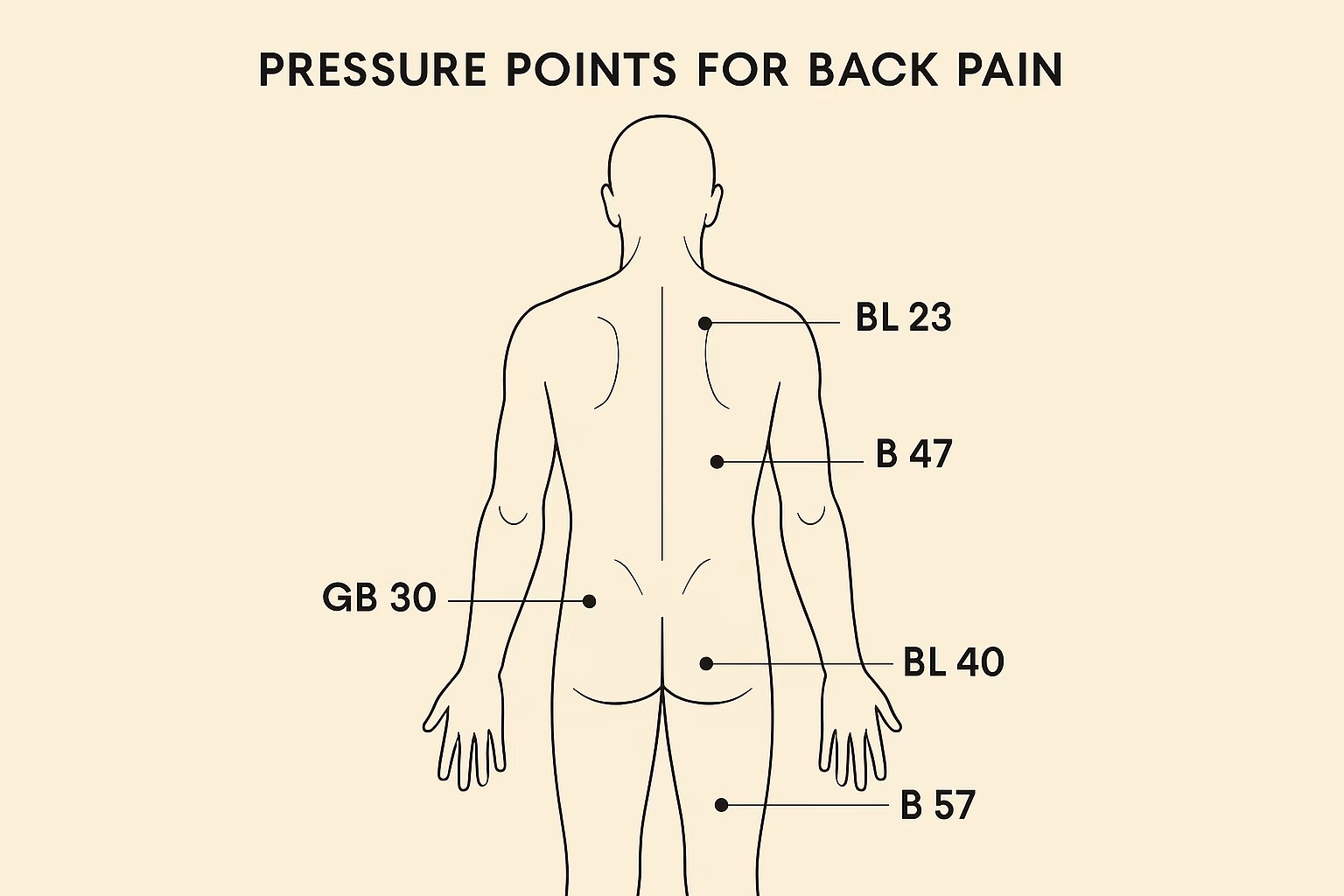
1. BL 23 (Shenshu) â The Lower Back Power Point
Where it is: About two finger-widths on either side of your spine, at the level of your waist (roughly in line with your belly button).
Why it works: BL 23 is one of the most important points in Traditional Chinese Medicine for kidney energy, which directly governs lower back strength. In modern terms, this point sits right over the quadratus lumborum and erector spinae muscles â two of the biggest contributors to lower back pain.
How to use it: Place your thumbs on both points simultaneously and press firmly while making small circular motions. Hold for 60 to 90 seconds. You should feel a deep, satisfying ache â not sharp pain.
This is the point I use most often. After a long day at my desk, 90 seconds of firm pressure here releases tension I did not even know I was carrying.
2. BL 40 (Weizhong) â The Back Pain Command Point
Where it is: The exact center of the crease behind your knee.
Why it works: In TCM, this point is literally called the “command point for the back.” It is the primary distal point for treating any back condition. Modern anatomy explains this through the sciatic nerve pathway â pressure here influences the entire posterior chain from your lower back down through your legs.
How to use it: Sit with your knee slightly bent. Use your thumb to press firmly into the center of the knee crease. Hold steady pressure for 60 seconds per side. If you have sciatica-type pain that radiates down your leg, this point is especially effective.
3. BL 60 (Kunlun) â The Ankle Point for Back Stiffness
Where it is: In the depression between your outer ankle bone and your Achilles tendon.
Why it works: This might seem far from your back, but BL 60 runs along the Bladder meridian â the longest meridian in the body, which traces the entire length of your spine. Stimulating this point can release tension throughout the back, particularly stiffness and acute pain.
How to use it: Use your thumb and index finger to pinch the area on either side of your Achilles tendon at ankle level. Apply moderate pressure and hold for 45 to 60 seconds. This works well for morning stiffness when your back feels locked up.
Important: Do not use this point if you are pregnant, as it can stimulate labor contractions.
4. GV 4 (Mingmen) â The Gate of Vitality
Where it is: On your spine, directly between the two kidneys â roughly at the level of your belly button, between lumbar vertebrae L2 and L3.
Why it works: Called the “Gate of Vitality” in TCM, this point is considered a primary source of energy for the entire lower body. Anatomically, it targets the deep paraspinal muscles and the lumbar spine directly.
How to use it: This one is hard to reach on your own. The best method is to lie on a tennis ball or lacrosse ball placed at this point on a firm surface. Let gravity do the work â start with 30 seconds and build to 2 minutes. You will feel a deep release in the lower back.
5. BL 25 (Dachangshu) â The Large Intestine Back Point
Where it is: Two finger-widths on either side of the spine, at the level of the top of your hip bones (L4 vertebra level).
Why it works: This point addresses the lower lumbar area where a huge percentage of back pain originates. It is particularly effective for pain that worsens after sitting for long periods or pain that comes with a feeling of heaviness in the lower back.
How to use it: Press with your thumbs on both sides simultaneously, angling slightly inward toward the spine. Hold for 60 seconds with firm, steady pressure. This pairs extremely well with BL 23 â work them together for a complete lower back release.
6. GB 30 (Huantiao) â The Hip and Sciatic Point
Where it is: On the side of your buttock, about one-third of the way from the top of the greater trochanter (the bony point of your hip) to the base of the tailbone.
Why it works: This point targets the piriformis muscle and sits directly over the sciatic nerve. If your back pain radiates into your hip or down your leg, GB 30 is critical. It is one of the most effective points for sciatica and piriformis syndrome.
How to use it: Lie on your side with the painful side up. Use a tennis ball or your elbow (if flexible enough) to apply firm pressure. Hold for 90 seconds to 2 minutes. You may feel a radiating warmth or a tingling sensation down your leg â that is normal and indicates the sciatic nerve is responding.
7. BL 54 (Zhibian) â The Deep Buttock Point
Where it is: About three finger-widths to the side of the base of your tailbone (sacrum), level with the fourth sacral foramen.
Why it works: This point addresses sacroiliac joint pain and deep gluteal tension â two extremely common causes of back pain that are often misdiagnosed as generic “lower back pain.”
How to use it: Lie face down on a firm surface with a tennis ball placed under this point. Allow your body weight to create the pressure. Hold for 60 to 90 seconds per side. Start gently â this area can be surprisingly tender.
8. LI 4 (Hegu) â The Master Pain Point
Where it is: In the fleshy web between your thumb and index finger, at the highest point when you squeeze them together.
Why it works: LI 4 is the body’s most famous general pain relief point. It triggers a broad endorphin release that can reduce pain perception throughout the body, including back pain. Research published in Evidence-Based Complementary and Alternative Medicine has confirmed its analgesic effects through fMRI studies showing it modulates pain-processing areas of the brain.
How to use it: Squeeze firmly between the thumb and index finger of your opposite hand. You will feel a distinct deep ache when you hit the right spot. Hold for 45 to 60 seconds per hand. I use this one as a first response whenever back pain flares up unexpectedly â it takes the edge off within minutes.
Important: Avoid this point during pregnancy.
9. DU 26 (Renzhong) â The Emergency Back Pain Point
Where it is: In the groove between your nose and upper lip, about one-third of the way down from your nose.
Why it works: This governing vessel point has a direct connection to the spine through the Du meridian, which runs along the entire back. It is used in TCM for acute back spasm and sudden severe back pain. Think of it as your emergency button.
How to use it: Press firmly with your fingernail or fingertip for 30 seconds. This is not a point for daily maintenance â use it when your back seizes up and you need quick relief.
10. SI 3 (Houxi) â The Upper Back and Neck Point
Where it is: On the outer edge of your hand, in the depression just below the pinky knuckle when you make a loose fist.
Why it works: SI 3 is the master point of the Du meridian (governing vessel) and is particularly effective for upper and mid-back pain, neck stiffness, and pain between the shoulder blades. If your back pain lives in the thoracic region â that area between your shoulders â this is your point.
How to use it: Press firmly with the thumb of your opposite hand into the depression below the pinky knuckle. Hold for 60 seconds per hand. This works beautifully for desk workers who carry tension between their shoulder blades.
11. GV 26 and BL 62 (Shenmai) â The Back Spasm Combination
Where BL 62 is: In the depression directly below the outer ankle bone.
Why this combination works: BL 62 opens the Yang Qiao vessel, which governs the muscles along the entire back. When combined with gentle work on the governing vessel, it addresses muscle spasms and acute back pain from the ground up.
How to use it: Press BL 62 firmly for 60 seconds on each ankle. This is particularly effective for back pain that worsens in the morning or after periods of rest.
How to Build a Daily Back Pain Pressure Point Routine
Working random points whenever you remember is better than nothing, but a consistent routine produces dramatically better results. Here is the sequence I have refined over 9 years of daily practice:
Morning routine (5 minutes):
- BL 23 â 90 seconds each side (lower back activation)
- BL 60 â 60 seconds each ankle (releases overnight stiffness)
- SI 3 â 60 seconds each hand (upper back and neck)
Desk break routine (3 minutes):
- LI 4 â 45 seconds each hand (general pain relief)
- BL 40 â 60 seconds each knee (posterior chain release)
Evening routine (5 minutes):
- BL 25 + BL 23 combination â 2 minutes (full lower back release)
- GB 30 â 90 seconds each side with tennis ball (hip and sciatic release)
- GV 4 on tennis ball â 90 seconds (deep lumbar decompression)
The first week you might not notice much. By week two or three, you will start to feel the difference â especially in the mornings.
Using an Acupressure Mat for Back Pain
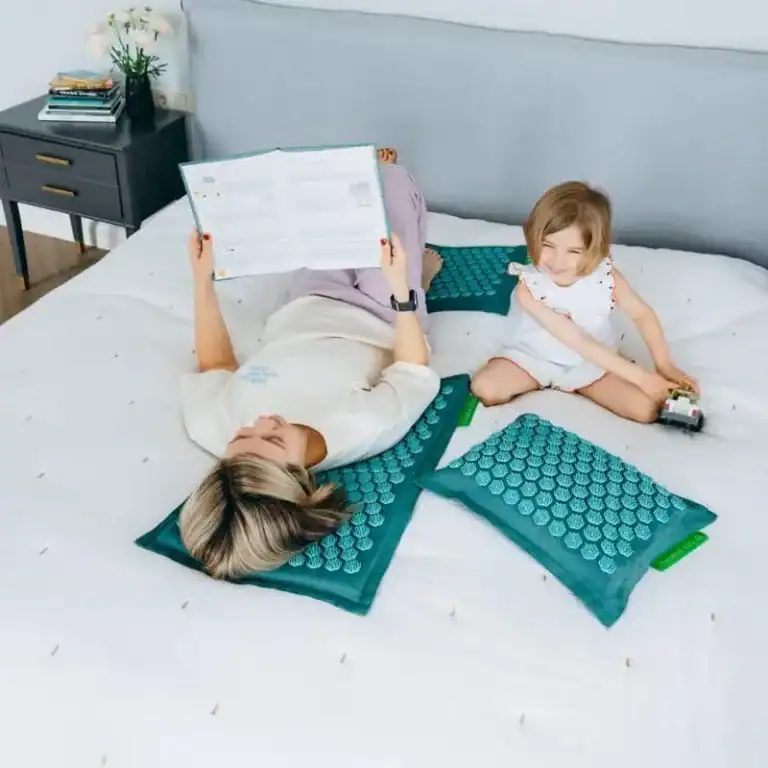
If pressing individual points sounds like too much work for daily practice, an acupressure mat is a practical shortcut. When you lie on a mat with thousands of small pressure points, you are stimulating the entire Bladder meridian along your spine simultaneously â including BL 23, BL 25, GV 4, and dozens of surrounding points.
I have been using my Pranamat almost every evening since 2017. Fifteen to twenty minutes lying on it targets the same back pain points we covered above, but without the need to reach awkward spots or hold specific positions. The mat does the work for you.
For back pain specifically, here is what I recommend:
- Start on a bed, not the floor. A softer surface lets you ease into the sensation without tensing up, which defeats the purpose.
- Lie with the mat under your lower back first. Position it so the top edge hits your mid-back and the bottom edge reaches your sacrum.
- Stay for 15 to 20 minutes. The first 3 to 5 minutes feel intense. Then your body relaxes, blood flow increases, and the pain relief kicks in.
- Use it before bed. The relaxation response carries over into sleep, and you will notice less morning stiffness.
If you want a deeper dive on mat techniques, I wrote a full guide on how to use an acupressure mat for lower back pain.
What the Research Says About Acupressure for Back Pain
The evidence base for acupressure and back pain has grown significantly in recent years:
- A 2019 meta-analysis in the Journal of Pain Research analyzed 15 randomized controlled trials and concluded that acupressure provides significant short-term relief for chronic low back pain.
- A 2021 randomized trial published in Complementary Therapies in Medicine found that six weeks of self-administered acupressure improved pain, fatigue, and quality of life in people with chronic low back pain.
- A 2020 study in Pain Medicine demonstrated that acupressure was more effective than physical therapy alone for reducing disability scores in chronic back pain patients.
- The National Institutes of Health recognizes acupressure as a complementary therapy with evidence supporting its use for pain management.
This is not a replacement for medical care if you have a serious spinal condition. But for the everyday back pain that comes from sitting too much, carrying tension, or just getting older â the evidence supports what I have experienced personally over 9 years.
Common Mistakes That Make Back Pain Worse
After years of practicing and teaching people these techniques, here are the mistakes I see most often:
Pressing too hard too fast. More pressure does not equal more relief. Start moderate and increase gradually. Your muscles need to relax into the pressure â if you go too hard, they guard and tense up even more.
Only working the pain site. If your lower back hurts, your instinct is to only press on your lower back. But distal points like BL 40 (behind the knee) and BL 60 (ankle) often provide faster relief because they release tension in the entire posterior chain.
Inconsistency. Doing a 30-minute session once a month is far less effective than 5 minutes every day. Your nervous system responds to repetition. Build the habit first, then refine the technique.
Ignoring referred pain patterns. Back pain often originates from your hips, glutes, or even your hamstrings. If BL 23 and BL 25 are not giving you results, try GB 30 and BL 54 â the issue might be in your piriformis or SI joint.
Holding your breath. Breathe slowly and deeply while applying pressure. Holding your breath activates your sympathetic nervous system, which increases muscle tension â the opposite of what you want.
When to See a Doctor Instead
Acupressure is effective for muscular back pain, tension-related pain, and chronic aches. It is not appropriate for:
- Sudden severe pain after a fall or injury
- Pain with numbness or weakness in your legs
- Loss of bladder or bowel control (this is a medical emergency)
- Pain that wakes you from sleep consistently
- Unexplained weight loss combined with back pain
- Pain that does not improve at all after 4 to 6 weeks of consistent practice
These symptoms may indicate a herniated disc, spinal stenosis, fracture, or other condition that needs medical imaging and professional treatment. Do not try to acupressure your way through a serious spinal condition.
The Bottom Line
Back pain is one of the most common reasons people come to acupressure, and for good reason â it works. The 11 points in this guide target every major cause of back pain, from lower lumbar tension to upper back stiffness to sciatic nerve compression.
Start with BL 23 and BL 40. Those two points alone can make a meaningful difference within a week of daily practice. Add the other points as you get comfortable, and consider an acupressure mat if you want a hands-free way to hit multiple back points simultaneously.
I have been doing this since 2017. My back is not perfect â I still sit at a desk too much. But the daily ache that used to define my afternoons is gone. That did not come from a pill or a one-time chiropractor visit. It came from consistent, targeted pressure on the right points.
FAQ
What is the fastest pressure point for back pain relief?
BL 40, located in the center of the crease behind your knee, provides the fastest relief for most types of back pain. It is called the “command point for the back” in TCM and can reduce acute pain within 60 to 90 seconds of firm pressure. For immediate relief during a flare-up, combine it with LI 4 on both hands.
Can pressure points help with sciatica?
Yes. GB 30 (on the buttock over the piriformis muscle) and BL 40 (behind the knee) are the two most effective pressure points for sciatic pain. GB 30 directly addresses the piriformis muscle, which is the most common non-spinal cause of sciatica. Apply firm pressure with a tennis ball for 90 seconds to 2 minutes per side.
How often should I do acupressure for back pain?
Daily practice produces the best results. Five minutes in the morning and five minutes in the evening is more effective than one long session per week. Most people notice significant improvement within two to three weeks of consistent daily practice. The key is building a routine you can maintain.
Is it normal for pressure points to hurt when you press them?
A deep, satisfying ache is normal and actually indicates you have found the right spot. Sharp, shooting pain is not normal â ease off the pressure or adjust your position slightly. Tender points often indicate areas of congestion or tension that need the most attention, so some discomfort is expected and productive.
Can I use acupressure if I have a herniated disc?
You should consult your doctor first. While gentle acupressure on distal points like LI 4 and BL 40 is generally safe, direct pressure near a herniated disc can worsen the condition. Avoid pressing directly on the spine or on points immediately adjacent to the disc injury. Work with a qualified acupressure practitioner who can tailor a safe protocol for your specific condition.
What is better for back pain â acupressure or massage?
They work differently. Massage addresses broad muscular tension across large areas. Acupressure targets specific neurological and energetic points for more focused relief. In practice, they complement each other well. For chronic back pain, I find that daily self-acupressure combined with periodic professional massage gives the best results.
Do acupressure mats work for back pain?
They do, and I say that from 9 years of daily use. An acupressure mat stimulates hundreds of points along your back simultaneously, which makes it far more efficient than pressing individual points by hand. A good mat like the Pranamat targets the entire Bladder meridian along your spine in a single session. Fifteen to twenty minutes per day is enough for most people to notice a significant reduction in back pain within two to three weeks.
Related Reading
- How to Use an Acupressure Mat for Lower Back Pain
- Lower Back Pressure Points for Pain Relief
- Acupressure Mat Benefits: 10 Science-Backed Reasons to Try One
- Do Acupressure Mats Work?
- Acupressure Mats and Fibromyalgia
📚 Clinical Studies: Acupressure for Back Pain
The information in this article is supported by peer-reviewed clinical research:
- Hsieh LL, Kuo CH, Lee LH, et al. Treatment of low back pain by acupressure and physical therapy: randomised controlled trial. BMJ. 2006;332(7543):696-700
- Mehta P, Dhapte V, Kadam S, et al. Clinical Efficacy and Safety of Acupressure on Low Back Pain: A Systematic Review and Meta-Analysis. Complement Ther Clin Pract. 2021;43:101349
- Yeh CH, Morone NE, Chien LC, et al. Self-Administered Acupressure for Chronic Low Back Pain: A Randomized Controlled Pilot Trial. J Pain Res. 2019;12:1983-1994
For more information about our research standards, visit our Editorial Process page.
Author

Free Mobile App
Find Pressure Points on the Go
Interactive 3D body map with 100+ acupressure points, step-by-step guides, and personalized routines.
Download Free App →