How to Do Acupressure on Yourself: Beginner’s Guide
You can do acupressure on yourself by pressing a comfortable point with your thumb, fingers, palm heel, or a soft massage ball for 30 to 90 seconds while breathing slowly. Keep the pressure broad and tolerable. Stop if pain becomes sharp, spreads, causes numbness or weakness, or feels unusual for your body.
Quick answer
| Step | What to do |
|---|---|
| Choose one point | Start with an easy-to-reach hand, wrist, foot, neck, or lower-back point |
| Find the area | Use a clear landmark, then feel for a mildly tender muscle spot |
| Apply pressure | Use steady, comfortable pressure, not digging or bruising force |
| Hold time | 30 to 90 seconds per point |
| Repeat | 1 to 3 rounds, switching sides when the point exists on both sides |
| Stop if | Pain shoots, tingles, numbs, weakens, worsens, or feels unsafe |
Key pressure points to know
Start with points that are easy to reach and easy to control. The goal is not to memorize every meridian. The goal is to learn how gentle pressure feels when it is applied safely.
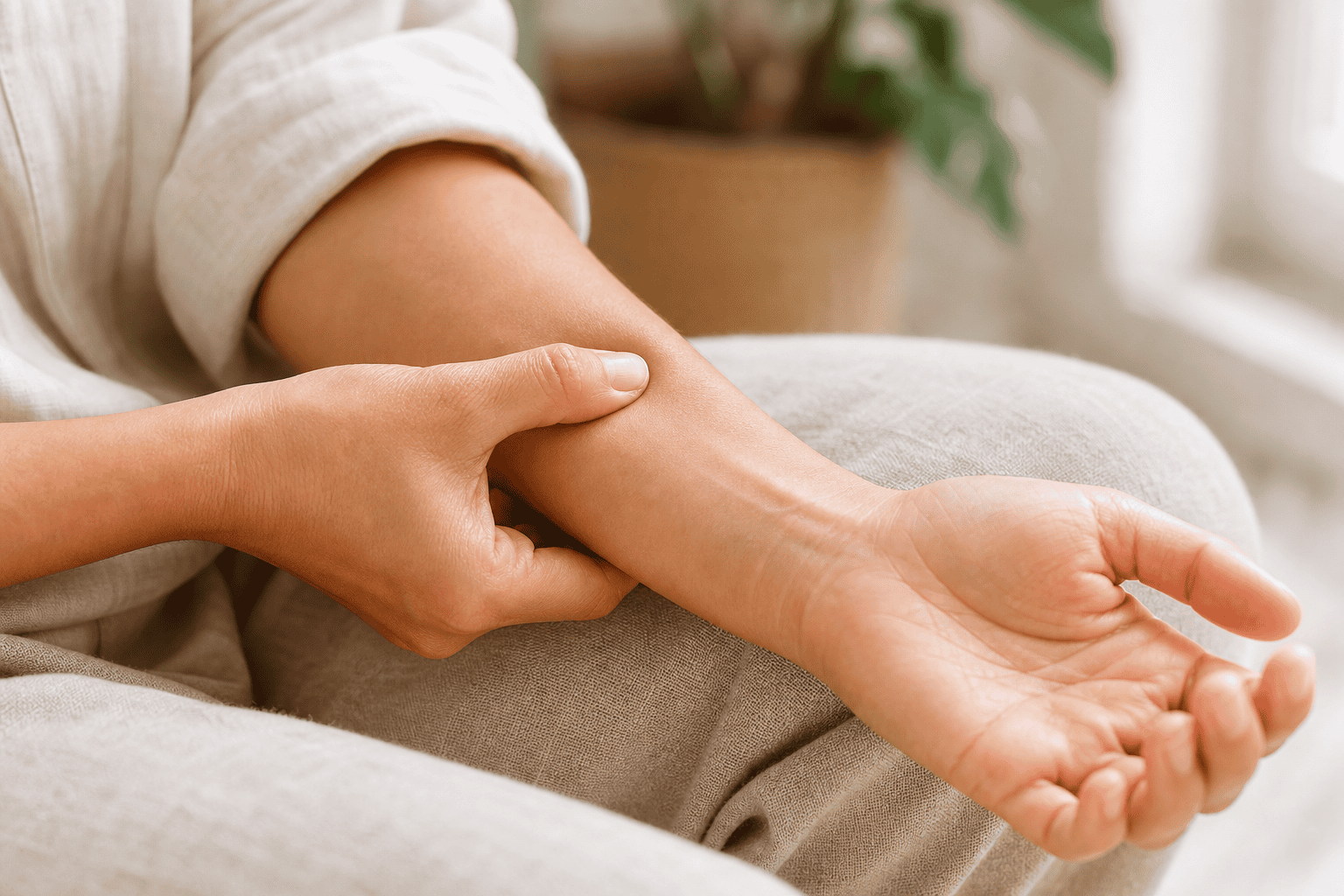
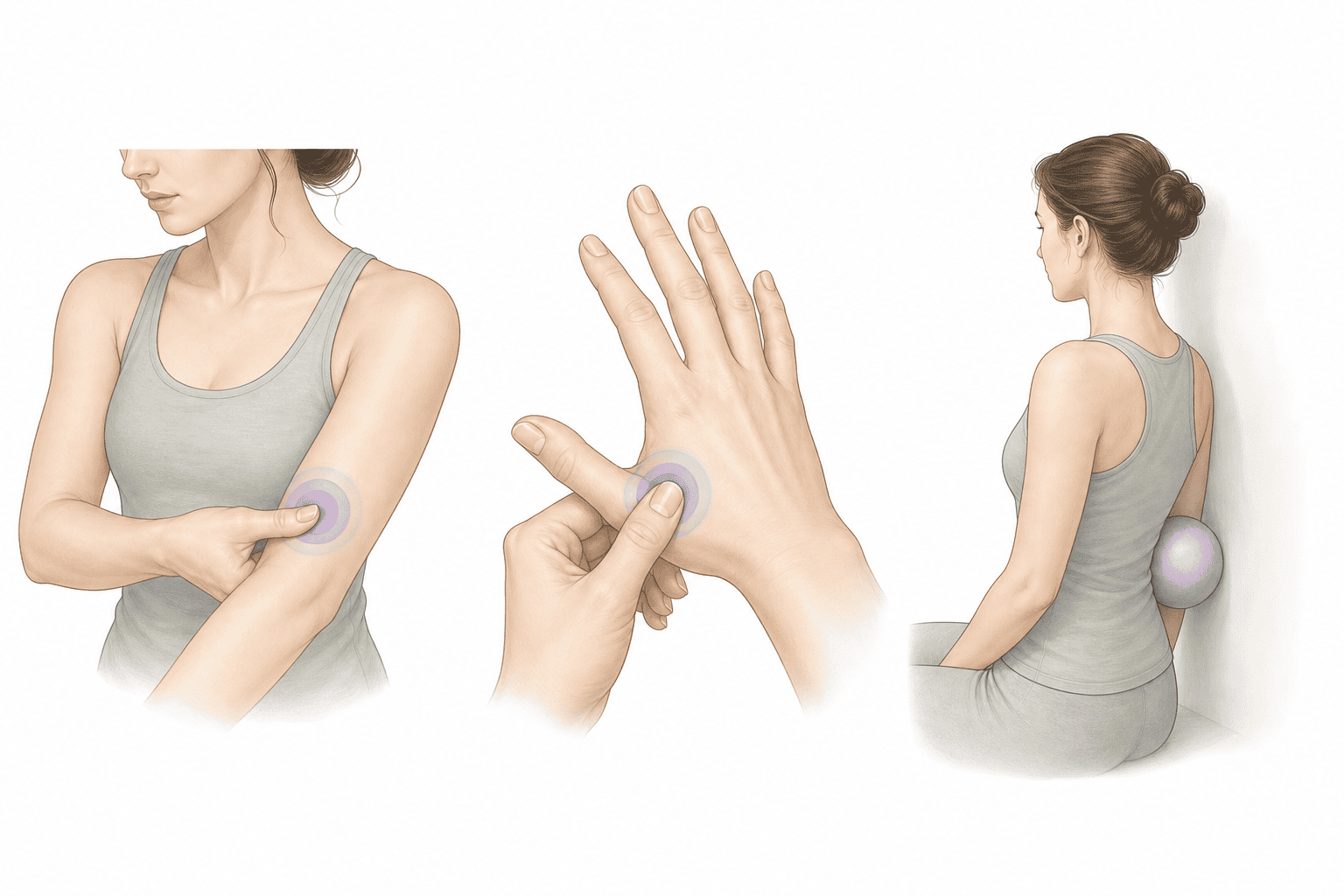
A hand point is often the simplest place to begin. Place your thumb or finger on a fleshy area, press slowly, and notice whether the sensation feels dull and tolerable. If the spot feels sharp, electric, or bruised, move away from it.
For lower-back self-care, use a soft massage ball against a wall rather than twisting your arm behind your body. The same principle applies to points like BL-25 Dachangshu: stay beside the spine, use broad pressure, and avoid forcing the bony ridge.
For jaw or face tension, use lighter pressure than you would use on the back or hips. If you are exploring jaw-related routines, compare the safety language in our TMJ pressure points guide. Facial and jaw areas are sensitive, so pressure should be smaller and shorter.
For motion-related nausea, wrist acupressure around the PC6 area is one of the more commonly studied examples. Our motion sickness pressure points guide goes deeper into that use case, but the beginner rule is the same: steady pressure, no pain, no medical promises.

How to use these points safely
First, get into a stable position. Sit, stand against a wall, or lie down in a way that lets your shoulder, jaw, belly, or lower back relax. If you have to twist, brace, or hold your breath to reach a point, choose a different method.
Second, start light. Place your thumb, fingertip, knuckle, palm heel, or soft massage ball on the area. Slowly increase pressure until you feel a dull, spreading, tolerable sensation. Hold for 30 to 90 seconds while breathing normally. Release gradually instead of snapping away.
Third, switch sides if the point exists on both sides of the body. Many acupressure points are paired. You do not need to press both sides at the same time. Work one side, pause, then work the other.
Fourth, keep sessions short. A beginner routine can be 3 to 8 minutes total. More time is not automatically better. Mild soreness can happen, but bruising, numbness, radiating pain, or worsening symptoms mean the pressure was too much or the point was not appropriate.
Fifth, use a simple sequence. Pick two or three points, not ten. For example, a beginner might use one hand point, one forearm or wrist point, and one lower-back or foot point depending on the goal. This makes it easier to notice how your body responds.
Actionable takeaway: Good self-acupressure feels controlled, steady, and repeatable. It should not feel like a test of pain tolerance.
Pressure Points App
Learn how to locate and apply pressure points with guided sessions, illustrations, and step-by-step instructions. Free to download.
A simple beginner routine
Use this structure when you do not know where to start.
- Pick one goal for the session, such as general relaxation, neck tension, jaw tension, nausea support, or lower-back comfort.
- Choose one easy point and one optional supporting point. Do not build a long routine on your first try.
- Press the first point for 30 to 60 seconds. Release and wait 15 seconds before deciding whether to repeat.
- Switch sides if the point is paired. Keep the second side lighter if the first side felt intense.
- End the routine before the area feels irritated.
For a first session, five minutes is enough. The useful feedback is not whether you can tolerate more pressure. The useful feedback is whether you can apply pressure calmly, breathe normally, and feel no sharp or spreading symptoms afterward.
If you are using a ball against the wall, keep your feet close enough to control the pressure. Lean in gradually. Rolling aggressively is not necessary. A still hold with slow breathing is usually easier to control than fast movement.
Common beginner mistakes
The most common mistake is pressing too hard. Strong pressure can make a point feel important, but it does not make the technique safer or more accurate. If you are grimacing, clenching your jaw, or holding your breath, reduce pressure.
The second mistake is chasing exactness too aggressively. Traditional point locations matter, but self-care should be practical. If you cannot find a precise point, use a broader, gentler area near the landmark instead of poking deeply.
The third mistake is using acupressure as a test for serious symptoms. If back pain follows a fall, if hand numbness appears suddenly, or if nausea comes with chest pain, do not experiment with pressure points. Use medical care first.
What the evidence says
The evidence for acupressure is mixed and depends on the symptom, point, study design, and comparison group. It is more reasonable to describe acupressure as supportive self-care than as stand-alone care for a health condition.
Memorial Sloan Kettering describes acupressure as something people can do at home by using the fingers to apply pressure to specific points, while still treating it as supportive care rather than a replacement for medical treatment (MSK acupressure for pain and headaches).
The U.S. Department of Veterans Affairs self-care handout describes acupressure as pressing or rubbing points, and it gives practical cautions such as avoiding areas with open wounds, infection, or a recent blood clot (VA acupressure for well-being PDF).
NCCIH discusses acupuncture more than acupressure, but its safety framing is useful for complementary approaches in general: do not use them to postpone medical care for a health problem, and consider safety before using them for pain or other symptoms (NCCIH acupuncture safety overview).
For PC6 wrist stimulation, evidence is more specific. A Cochrane review of PC6 acupoint stimulation for postoperative nausea and vomiting found reductions in nausea, vomiting, and rescue antiemetic use compared with sham treatment, but the intervention category included several stimulation methods, not only hand-applied acupressure (Cochrane PC6 review).
This is why the safest language is cautious. Acupressure may help some people with some symptoms, but the research does not prove that every point works for every person.
Related pressure points
Use related guides when you want a more specific routine:
- BL-25 Dachangshu for a lower-back pressure point example.
- Acupressure points for frozen shoulder for shoulder-focused self-care.
- TMJ pressure points for jaw tension routines.
- Pressure points for motion sickness for wrist-focused nausea support.
- Pressure points for sore throat for a symptom-specific example with safety limits.
The best way to use these pages is to pick one goal at a time. A lower-back routine, jaw routine, and nausea routine should not all be mixed together in one beginner session.
When to get medical help
Do not use self-acupressure as home care for sudden, severe, unusual, or worsening symptoms. Get medical help for chest pain, shortness of breath, fainting, severe headache, new weakness, numbness, confusion, fever with severe pain, injury after a fall, loss of bladder or bowel control, or symptoms that feel neurological.
Avoid pressing over broken skin, rashes, bruises, swelling, varicose veins, recent surgery sites, implanted devices, or areas with reduced sensation. People with bleeding disorders, recent blood clots, fragile skin, neuropathy, osteoporosis, cancer treatment complications, or advanced spine disease should ask a qualified clinician before using strong pressure.
Pregnancy needs extra care. Some points are traditionally avoided or used only by trained practitioners during pregnancy. If you are pregnant, trying to become pregnant, or recently postpartum, use only gentle comfort touch unless your clinician or licensed practitioner gives specific guidance.
Frequently asked questions
How hard should I press?
Use enough pressure to feel a dull, comfortable sensation, but not enough to create sharp pain, bruising, tingling, numbness, or breath-holding. On the face, neck, wrist, and abdomen, use lighter pressure than you would use on the hips or lower back.
How long should I hold a point?
Most beginner routines use 30 to 90 seconds per point. You can repeat 1 to 3 rounds if the area feels comfortable afterward. If the tissue feels irritated, shorten the time or skip the point.
Can I do acupressure every day?
Many people use gentle acupressure daily as a short self-care routine. Keep the session brief and watch how your body responds. Daily pressure is not appropriate on bruised, swollen, irritated, numb, or injured areas.
What should acupressure feel like?
It should feel steady, dull, warm, or mildly tender. It should not feel sharp, electric, spreading, or alarming. A useful rule is simple: if your body wants to pull away, reduce pressure or stop.
Is it normal if a pressure point hurts?
Mild tenderness can happen, but pain is not a diagnostic sign and it is not something to push through. If a point feels sharp, electric, unusually intense, or makes symptoms spread, stop and use lighter pressure next time. If the pain is severe, new, or worrying, use medical care instead of testing more points.
Can I press several points at once?
Beginners should usually start with one point, then one optional supporting point. Pressing many points at once makes it harder to tell what helped, what irritated the area, or whether you used too much pressure. Keep the first routine simple and build only after you know how your body responds.
Is self-acupressure safe for beginners?
It can be reasonable when pressure is gentle, points are easy to reach, and red-flag symptoms are absent. It is not a substitute for diagnosis, urgent care, physical therapy, medication, or treatment from a qualified clinician.
Bottom line
Self-acupressure is easiest to learn when you keep it simple: choose one or two accessible points, use gentle pressure, hold for 30 to 90 seconds, and stop at the first sign of sharp, spreading, neurological, or unusual symptoms.
Use acupressure as supportive self-care, not as a way to diagnose or treat a medical condition. The better you respect those limits, the more useful and repeatable the practice becomes.
This article is for educational purposes only and is not medical advice. Acupressure may be useful as supportive self-care, but it should not replace diagnosis or treatment from a qualified clinician. Seek urgent care for severe, sudden, or worsening symptoms.
Author

Free Mobile App
Find Pressure Points on the Go
Interactive 3D body map with 100+ acupressure points, step-by-step guides, and personalized routines.
Download Free App →